Moving Companies Network: Plan Your Move
A useful move plan begins with the work your household actually needs. This guide brings the major decisions together so you can choose a service, prepare your belongings, and keep the handover manageable.
Use the steps below as a working guide. Read the whole sequence once, then return to the part that matches your next decision. Adapt the order to your household and the arrangements you have confirmed. Keep open questions visible until the person responsible has answered them, and update your plan whenever the inventory, access, or timing changes.
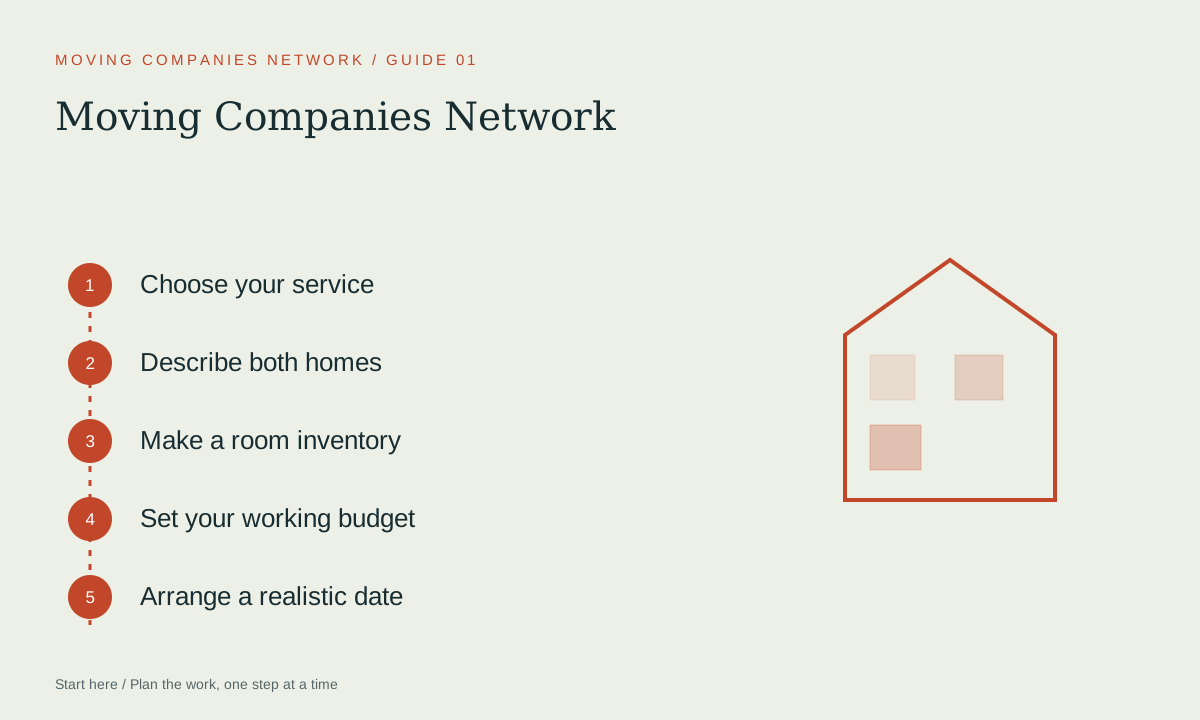
1. Choose your service
Compare full service, labor only, container delivery, and a rented truck against the time and help you have available.
Start by writing down the result you need from this step. A useful task has an owner, a place, and a clear point at which it is finished. That keeps a broad intention from becoming another unanswered question on moving day. Work from the belongings and access arrangements you actually have, and keep assumptions separate from confirmed information.
Before moving on, check the result against the next step in the plan. If another person needs your answer before they can work, send it to them in a form they can use. A short accurate note is more useful than a long description that omits the detail they need. Keep a copy with the current moving record so the same question does not have to be answered again.
2. Describe both homes
Record stairs, elevators, parking, walking distance, narrow doors, and any limits on delivery hours at each address.
Look at the actual space or belongings involved rather than relying on memory. Small differences become important when somebody else must plan equipment, allocate time, or decide what to bring. Record the information where the household coordinator can find it, and explain anything that could be misunderstood from a brief description.
Treat an unanswered question as an open task. Choose who will obtain the answer and when it is needed. If a provider or building contact supplies information, record the practical instruction and the person who supplied it. Check that the answer applies to your address, your dates, and the service you are arranging. Information from a different move can suggest a question, but it cannot confirm the arrangements for this one.
3. Make a room inventory
List furniture separately from packed boxes so a provider can understand bulky items and unusual handling needs.
This step becomes harder when cartons and furniture begin to block access to the things you need to inspect. Deal with it while you can still see the relevant belongings and make a calm decision. Ask the other household members who use those belongings for their input before fixing the plan.
Give the decision a practical consequence. Update the inventory, change the room list, or tell the person doing the work what has been agreed. Keep the previous version out of the active paperwork so helpers do not follow conflicting instructions. If the decision remains provisional, say what information is missing and when you expect to resolve it. That prevents a tentative idea from being mistaken for a confirmed arrangement.
4. Set your working budget
Separate transport, packing supplies, travel, storage, and first night expenses before comparing the headline prices.
Break the work into a group you can finish with the time and space available. Starting too many things at once creates half completed piles and makes the home harder to use. Keep a clear working surface and a defined place for the finished items or records before beginning the next group.
At the end of the session, check that the completed work can be understood by someone who was not present. Put the relevant label or note where it belongs and return tools and materials to their designated place. This is particularly useful when different helpers work on different days. It lets the next person continue from a clear stopping point instead of reopening decisions or undoing work that was already complete.
5. Arrange a realistic date
Check access to the new home before committing to loading, travel, and unloading on the same day.
Decide who is responsible for this part of the move and what that person needs from everyone else. A shared task still needs a clear contact when questions arise. Discuss the limits of any help you have arranged, especially where the household, a moving crew, and a property contact each handle different parts.
Write the agreed responsibility beside the task. Include any preparation that must happen before the responsible person can start. If the arrangement changes, tell everyone affected rather than assuming the information will pass through the group. Where work requires particular knowledge or equipment, obtain suitable help before committing to a method. Do not turn an unresolved responsibility into a hurried experiment simply because the vehicle or helpers have arrived.
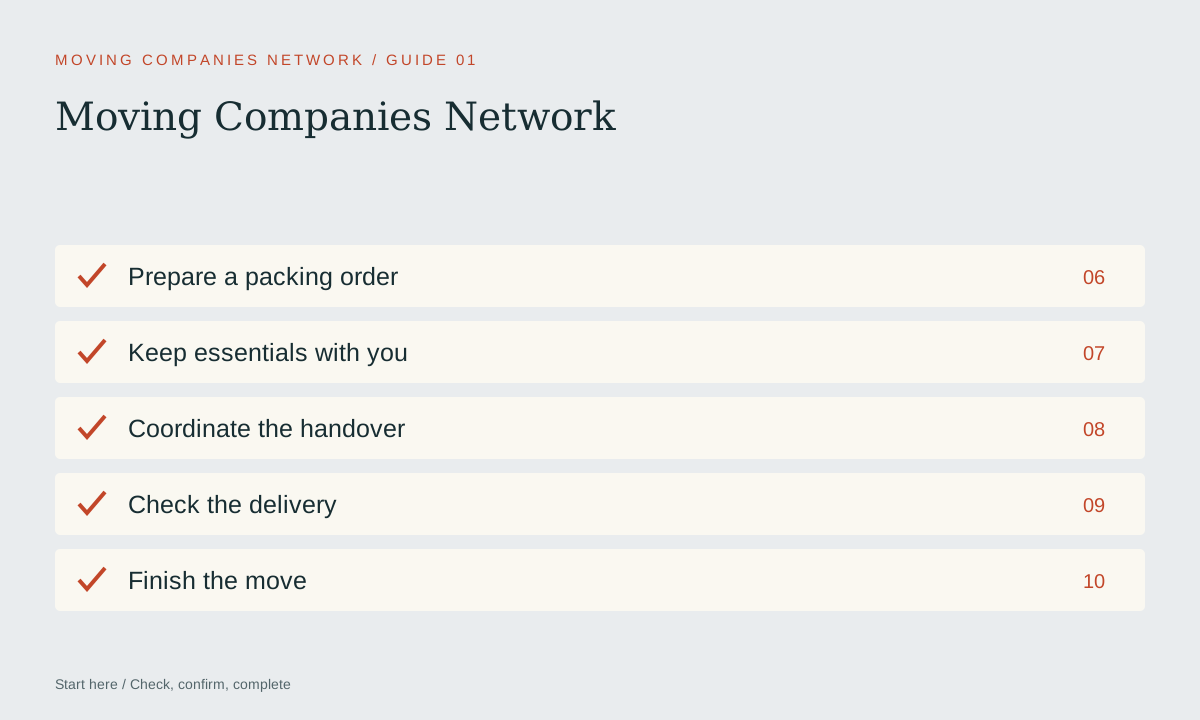
6. Prepare a packing order
Start with belongings you seldom use and leave a small working set for the final days.
Think about what happens when this part of the work passes to another person. The next person needs enough information to continue without guessing. Use the room names, item identifiers, and contact details already established for the move rather than introducing a new naming system halfway through.
Make the handover visible. Put the relevant information in the current record and check that the person receiving it understands the action required. If something must remain accessible, identify its location as well as its name. If something must wait, explain the condition that allows work to resume. This small amount of preparation reduces the chance that a helper will make an understandable choice that conflicts with the household plan.
7. Keep essentials with you
Carry keys, identification, medication, chargers, and the documents needed to enter your new home.
Identify the part of this step that is most likely to change before the move is complete. It might depend on access, the final inventory, another person, or information you have not yet received. Keep a simple fallback that fits your actual situation rather than adding several complicated alternatives.
A fallback needs a trigger and a contact. Decide what event would make you use it and who needs to know. If the change affects a booked service, ask the provider how it wants the update communicated. Keep the response with the booking information. Recheck the household plan after the change so travel, access, and essential supplies still fit together. One revised detail can affect another task even when the overall move remains the same.
8. Coordinate the handover
Give one household member responsibility for questions while someone else checks room labels and remaining belongings.
Use a location and description that will still make sense when the home is busy. A note hidden in a private conversation or an unmarked carton does little for the person who needs it. Keep necessary information accessible while protecting personal details that do not need to be shared with helpers.
Test the system by asking whether another household member could find the result without your explanation. Improve the label or record if the answer is uncertain. Consistency matters more than elaborate formatting. The same room name and item identifier should follow the belongings through preparation, transport, and arrival. When the physical arrangement changes, update the record so the description continues to point to the right place.
9. Check the delivery
Compare arriving items with your inventory and photograph visible damage before packaging disappears.
Compare the completed task with what you intended to achieve. Look for an omitted item, an unclear instruction, or a dependency that still has no owner. Checking now is usually easier than reconstructing the decision later, after belongings have been wrapped, loaded, or spread across rooms.
Keep any unresolved point separate from the finished work. Describe the issue precisely enough that the right person can respond without repeating the whole planning conversation. Where a photograph helps explain condition or access, keep it associated with the relevant inventory entry. Avoid treating a completed checklist mark as a substitute for looking at the actual result. The purpose of the record is to support the work, and it should reflect what has really happened.
10. Finish the move
Unpack sleeping and washing supplies first, then close out address changes and any unresolved service questions.
Consider how this decision will work at the destination. A method that is convenient while packing can be awkward when you need one item during the first evening. Use the new room layout and the household routines you expect to resume as the test for whether the arrangement is useful.
After arrival, close the task only when the result has been checked. If something is missing or unclear, note it while the packing and delivery details are still easy to recall. Keep the records needed to follow up and put unrelated paperwork aside. Once the point is resolved, update the household list so attention can move to the remaining work. A clear finish keeps small unfinished matters from being lost among ordinary unpacking jobs.
Keep a useful working record
A useful record separates confirmed arrangements from questions. Give each open question an owner and a next action. Include the item, room, or booking detail involved so the answer can be applied without another search. Review this record before packing starts, before loading, and after arrival. Keep any supporting instructions with the relevant task so the next person can understand both the decision and what remains to be done.
Putting the plan into practice
Start with access rather than a packing purchase. Knowing when you can enter the new home determines when transport and unloading can happen. Knowing when you must leave the old home identifies the final deadline. If the two dates do not align, resolve the gap before arranging a load that has nowhere to go. The answer might involve a different schedule, a temporary stay, or a storage arrangement, depending on the household's actual options.
Choose the amount of help around the work involved. A household with a small inventory and suitable transport has different needs from one moving several floors of large furniture. Consider available time, equipment, access, and the ability of helpers to complete the work. A price comparison becomes useful only after these practical requirements are described. Keep the tasks you retain on the household checklist so paying for one service does not conceal work that still needs an owner.
Plan household travel separately from the belongings. The moving vehicle's timetable may not provide a practical journey for everyone leaving the home. Decide who carries personal bags, who can open the destination, and who remains available to answer questions at departure. Keep a contact record that both groups can access. If one person holds the only key or the only copy of essential information, make that dependency visible before the move begins.
The first useful inventory can be simple. Walk through the home and list large furniture before estimating cartons. Add places that are easily forgotten, including outdoor storage, shared lockers, and cupboards behind doors. Mark anything that needs a separate discussion about preparation or acceptance. Improve the list as packing progresses rather than waiting to create a perfect record at the end. The important point is that the transport description matches the belongings you intend to move.
Make the first evening a separate small project. Identify a sleeping arrangement, washing supplies, an easy meal, and the devices needed to manage the next day. Keep these supplies with the household where practical. If some must travel in the load, label their containers clearly and tell the unloading coordinator where they should go. This gives you a usable stopping point even when the rest of the home remains full of unopened cartons.
Review the plan at each handover. Packing changes what can be inspected, loading changes what remains accessible, and delivery changes where belongings can be found. At each stage, check that the inventory and contact record still describe the situation. Close finished tasks and identify any open question that could affect the next stage. Keep the notes practical enough that someone helping for only part of the day can understand what needs to happen.
Keep one current version of the plan and date important updates so helpers can recognize which information to use. Ask for a specific answer when a description is unclear, and repeat the agreed action in your own words before work starts. Check both the old home and the destination whenever a decision depends on available space, access, or the order of delivery. Choose a method that the household can maintain during a busy day rather than one that depends on perfect attention.
Keep sensitive personal details in the private record and share only the practical information a helper needs for the task. Leave a clear route to the belongings still in daily use so finishing this task does not make another essential activity difficult. When timing is uncertain, identify the next confirmation you need and the person who can provide it. Allow time to finish the record as well as the physical work, because an incomplete note can create another search later.
If a task depends on equipment instructions, keep those instructions accessible until the item has been prepared and checked again. Tell the household coordinator when a task is complete so the next activity can begin without unnecessary waiting. Use plain room names and short descriptions that remain readable when belongings are stacked or the coordinator is working from a phone. Review assumptions with the person doing the work before treating the plan as ready.
Write down the next action. Keep the current record accessible. Check the destination room. Confirm the agreed timing.
Keep labels readable. Check access again. Record the change. Confirm details.
Keep a separate copy of essential contact details available during the journey between the two homes. Read the instructions before changing an arrangement that another person is already following. Before departure, review the task marked “choose your service” and confirm that its result is recorded where the household coordinator can find it. Before departure, review the task marked “describe both homes” and confirm that its result is recorded where the household coordinator can find it.
Before departure, review the task marked “make a room inventory” and confirm that its result is recorded where the household coordinator can find it. Before departure, review the task marked “set your working budget” and confirm that its result is recorded where the household coordinator can find it. Before departure, review the task marked “arrange a realistic date” and confirm that its result is recorded where the household coordinator can find it. Before departure, review the task marked “prepare a packing order” and confirm that its result is recorded where the household coordinator can find it.